
Your genome, ready to connect and explore.
Delivered in 2–3 weeks and updated for life.
Order now
Order your genome
Get your genome sequenced, annotated and delivered in .genomeThe open genome format we developed for portable personal context. Fully annotated and yours to download, connect and explore. format.
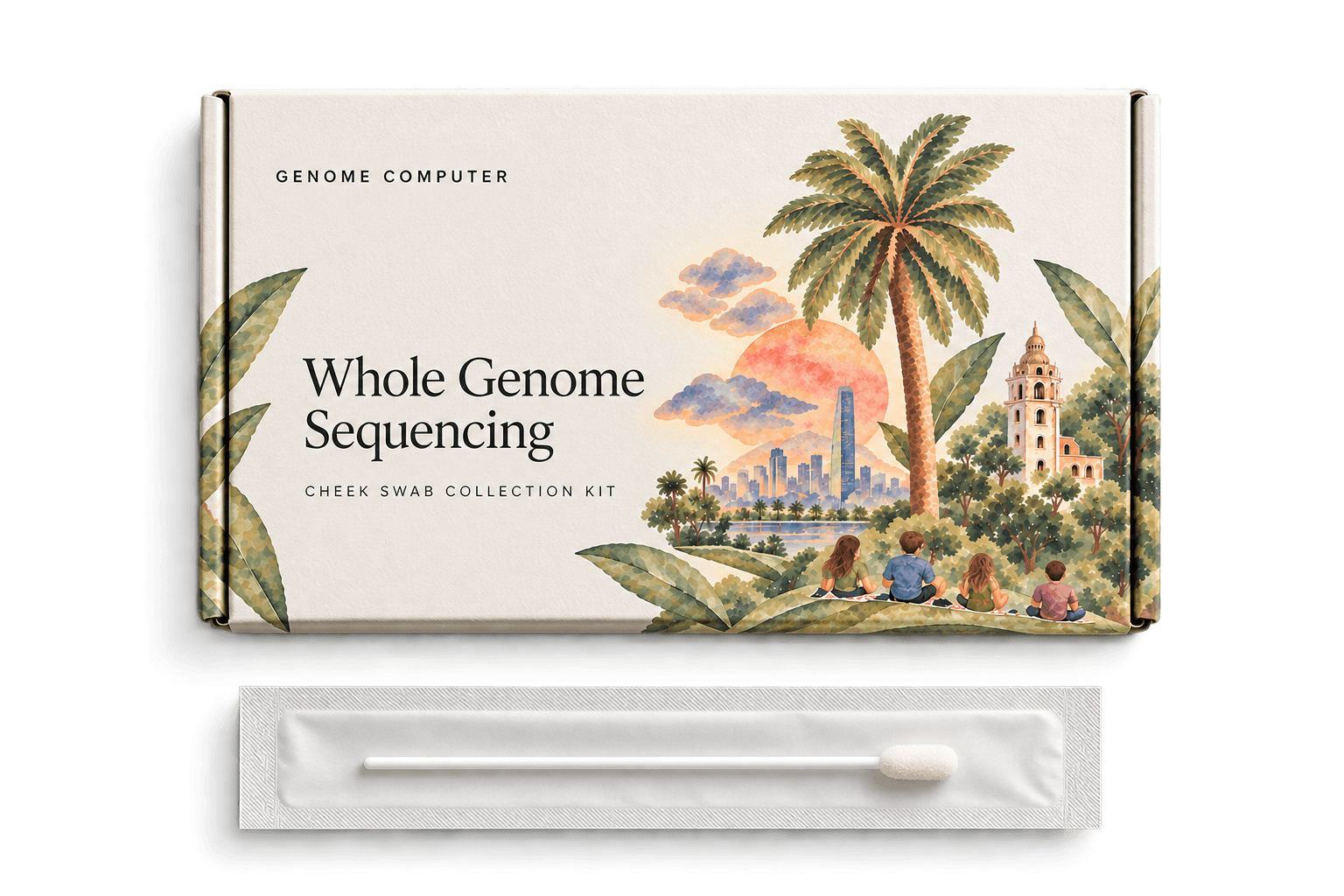
Whole genome, 30x
$499The complete foundation for lifelong exploration. Download and explore offline or connect to any tool via MCP.
- 30x genome coverage
- 2-3 week turnaround
- MCP Connector
- gVCFUnlike the VCF files legacy providers deliver, a gVCF preserves both your genetic variants and the confidently sequenced regions between them, making your genome more useful for future analysis. and FASTQA FASTQ file contains the raw DNA sequencing data exactly as it comes off the sequencing machine. available on request
- Backed by our privacy commitment
Our Privacy Commitment
We believe everyone should be able to access and explore their genome. We built Genome Computer to be the company we’d trust with our own.
- Your sample is de-identified before sequencing. Our laboratory partners receive no personally identifiable information or protected health information with your sample.
- Your genetic data cannot be sold or licensed. Neither Genome Computer nor our laboratory partners can sell, license or commercially distribute your genomic data, including de-identified or aggregated datasets.
- Your genetic data is never used to train AI models. We don't use your identifiable genomic data for model training or license it to others for that purpose.
- We don't use your genome for research. There is no hidden or optional research program, and we don't share your data with researchers or pharmaceutical companies.
- Collection devices and residual samples are destroyed five days after results are delivered. DNA samples and sequencing deliverables are deleted after 90 days. You can also request earlier deletion.
- These protections follow your data. Our and our labs' subprocessors are bound by contractual data-protection requirements.
FAQ
What do I get?
A .genome bundle — an open file built so models, agents, and apps can use your genome as context — plus readmygenome.md, so Claude or Codex can read it correctly from the first prompt.
You also get the standard sequencing files: gVCF and FASTQ. Yours to keep.
Connect the .genome file over MCP to ChatGPT, Claude, Codex, or any other tool. Or call it through the Genome API and build on it yourself. You can also download the files and use them offline.
What reference build do you use?
What is a .genome file?
.genome is an open file format for genome data, designed for self-exploration. It uses the same underlying data as a VCF, but restructures it so tools like Codex and Claude code can process it reliably without relying on partial parsing or guesswork.
Under the hood it's not one flat file but a structured, queryable bundle (format version .genome/1.0). Your variants are stored in fast columnar tables alongside the annotations that give them meaning — trait associations, the supporting research behind them, gene-level context, polygenic scores, and pharmacogenomics — so a tool can answer questions against your whole genome directly.
Compared to raw VCF files, .genome reduces token usage by 3–10× while reducing factual errors by 10–20×.
How is this different from raw sequencing providers?
Raw sequencing providers usually deliver technical files — FASTQ, BAM/CRAM, VCF, or a static report. Those files are valuable, but they're hard to inspect, hard to keep updated, and not designed for AI tools to reason over directly.
Most providers tell you what variants you have. Genome Computer tells you what you have and what it means: variants, annotations, trait evidence, pharmacogenomics, polygenic scores, provenance, and prompts in one portable format you can use with Codex, Claude Code, or any tool of your choosing.
For sequencing orders, we build from a gVCF instead of only a consumer-style VCF. A VCF mostly lists the places where you differ from the reference genome. A gVCF also preserves the confidently sequenced regions where no variant was found, which helps distinguish "no variant here" from "we do not know because this position was not confidently covered."
The difference is that you're not just receiving raw output from a sequencer. You're receiving a self-explorable genome you can keep, query, re-annotate, and explore as the science changes.
What can I do with it?
A .genome file is a portable container for your genetic data. The point is that it travels with you and works inside any tool that can read a file, so you're not locked into one platform's interface.
Concretely, you can:
- Drop it into an AI coding/agent tool — Codex, Claude Code, Cursor, or anything that can ingest a file — and treat your genome as queryable context. The file format (.genome/1.0) is structured so the model can parse variants, archetype data, and phenotype context directly.
- Ask open-ended questions — "What does my genotype suggest about caffeine metabolism?", "Which of my variants relate to sleep?", "How should I read my stress-recovery axis?" — and get answers grounded in your actual data rather than generic advice.
- Test hypotheses — pull in a paper or a new GWAS finding and ask the tool to check it against your specific genotypes, so you can see whether a result actually applies to you.
- Stay current — re-run analysis as new research lands (ClinVar/PharmGKB updates, new associations) without re-sequencing. The same file gets re-interpreted against newer knowledge.